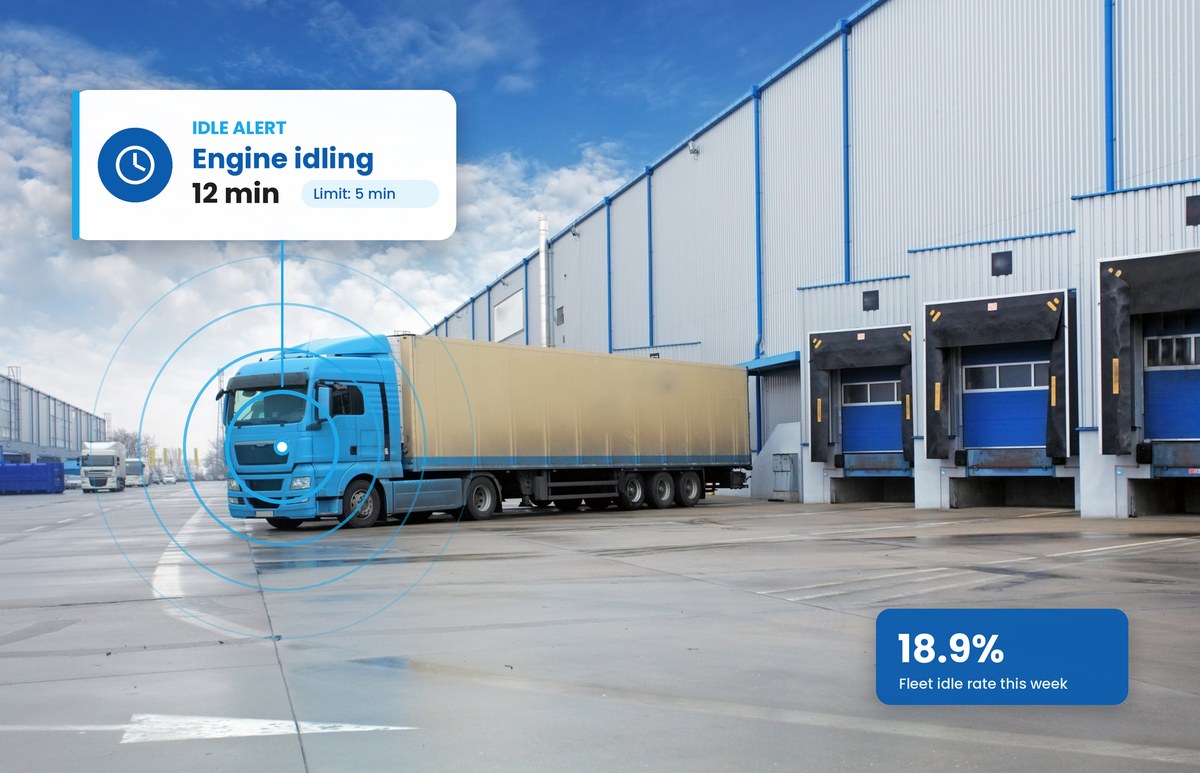
Every minute a vehicle sits stationary with its engine running, it burns fuel and covers zero miles. With UK diesel close to £2 a litre in October 2026, unnecessary idling has become one of the easiest costs for a fleet to cut, as long as you can see it.
What is vehicle idling?
Vehicle idling is when a vehicle’s engine is running, but the vehicle is not moving. Some idling is unavoidable, such as sitting in traffic or at lights. Much of it is not. Common causes of unnecessary idling in commercial fleets include:
- Waiting at a customer site for loading or unloading
- Keeping the cab warm or cool during breaks
- Leaving the engine running during short drop-offs
- Warming up the engine for longer than needed on cold mornings
- Waiting for a collection, a booking slot or a colleague
The challenge for fleet managers is that idling is usually invisible. A driver idling for 15 minutes at each of four drops can add an hour of wasted engine time to every shift, without anyone in the office knowing.
How much does vehicle idling cost a business?
One hour of idling a day can cost around £1,500 a year per HGV at current diesel prices. Idling vans typically burn 0.8 to 1.5 litres of fuel per hour, and HGVs 2 to 4 litres per hour (Right Fuel Card). UK diesel averaged 198.8p per litre in the week to 18 October 2026 (Fuel Finder UK).
| Vehicle | Litres per idle hour | Cost per idle hour | Per year, 1 hr/day | 50 vehicles |
|---|---|---|---|---|
| Van (diesel) | 0.8–1.5 | ~£2.29 | ~£572 | ~£28,600 |
| HGV (diesel) | 2–4 | ~£5.97 | ~£1,493 | ~£74,600 |
Based on the midpoint of each range (1.15 L/hour for vans, 3 L/hour for HGVs), diesel at £1.99 per litre and 250 working days a year.
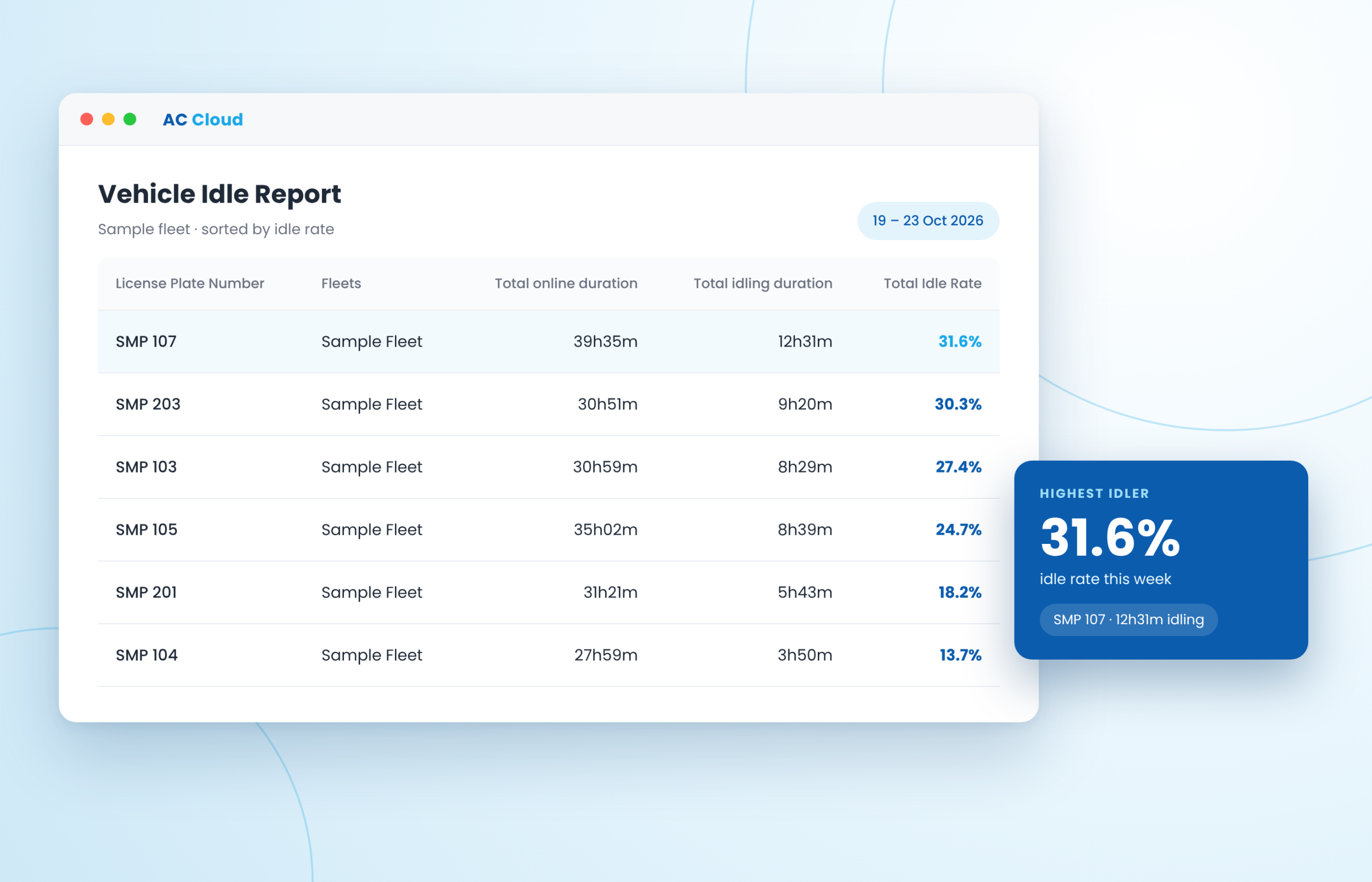
Idle time and idle rate for every vehicle, recorded automatically in AC Cloud.
Fuel is only part of the cost. Idling also:
- Adds engine hours without adding miles, which can bring service intervals forward
- Increases wear on engine components, as an engine is not running at its most efficient temperature or load while idling
- Can lead to fines if drivers idle on public roads (see the legal rules below)
- Raises your fleet’s reported emissions, which matters for customers and tenders that ask for carbon data
The hidden risks of vehicle idling
Fuel is the most visible cost, but idling also affects your vehicles, your drivers and your security.
Vehicle idling statistics in the UK
Is vehicle idling illegal in the UK?
Yes, unnecessary idling on a public road is an offence. Rule 123 of the Highway Code says drivers must not leave a parked vehicle unattended with the engine running, or leave an engine running unnecessarily while stationary on a public road (Welsh Government). How it is enforced depends on where you operate:
| Where | Typical penalty | Notes |
|---|---|---|
| Wales | £75–£150 | New range from 30 September 2026; higher fines possible near schools and hospitals (guidance) |
| England & Scotland | £20 | Usually only if a driver refuses to switch off when asked (Confused.com) |
| Construction & Use offence | £40–£110 | £40 police, £80 civil enforcement, up to £110 in boroughs such as Islington (RAC via Ground News) |
| Local orders (PSPOs) | Up to £100 | Used by some London boroughs (Local Government Lawyer) |
For fleet operators, individual fines are small. The bigger risk is repeated penalties across many drivers, reputational damage when branded vehicles are seen idling outside schools or homes, and the lack of a clear idling policy if a customer or regulator asks.
The environmental impact of vehicle idling
Idling also releases nitrogen dioxide (NO2) and particulate matter (PM2.5), which harm local air quality. The Welsh Government links idling emissions to heart and lung disease, with children outside schools and people near healthcare settings most exposed (Welsh Government).
For operators, this matters beyond compliance. More customers and public-sector tenders now ask for carbon and emissions data. Cutting idling is one of the quickest ways to show measurable progress without changing vehicles.
How to track and reduce vehicle idling with AC Cloud
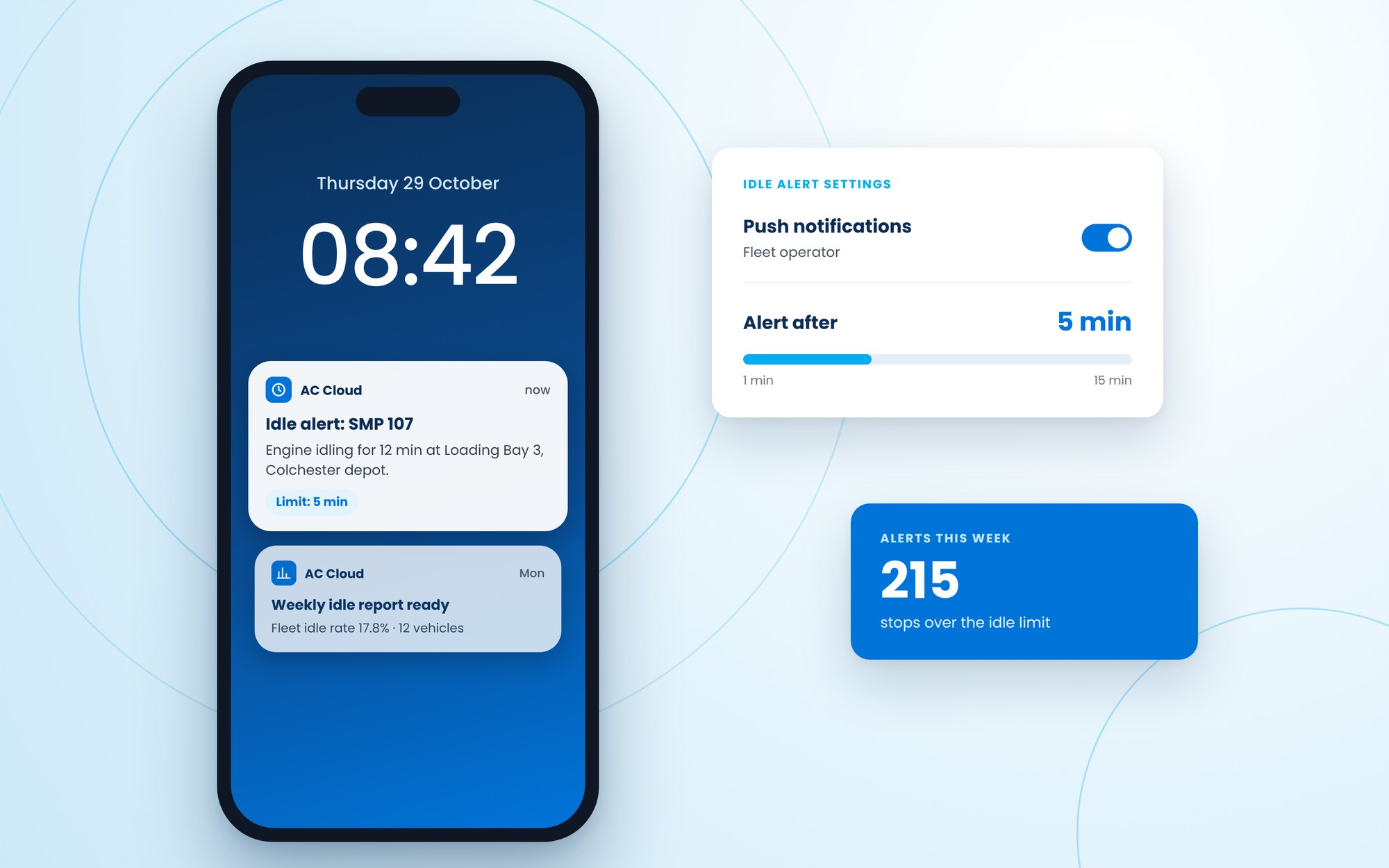
You can’t reduce what you can’t measure. AC Cloud, the ACSS platform for live-view vehicle CCTV and telematics, records idle time on every trip automatically, so fleet managers can see exactly where, when and how long vehicles are idling. See every feature in one place →
6 practical ways to reduce idling in your fleet
Technology that removes the need to idle
Drivers often idle to stay warm, keep cool or power equipment. These technologies let them do that with the engine off:
| Technology | What it does | Best for |
|---|---|---|
| Night heaters | Heat the cab using far less fuel than the engine | HGV drivers on breaks or sleeping in the cab |
| Battery cab air con | Cools the cab from a separate battery | Long breaks in warm weather |
| Stop-start systems | Switch the engine off automatically when stopped | Vans and urban delivery vehicles |
| Electric vehicles | No engine to idle; heating and cooling still use charge | Urban and short-range routes |
Frequently asked questions
What is vehicle idling?
When a vehicle’s engine is running but it isn’t moving, for example while parked, waiting at a site or sitting in traffic.
How long can you leave an engine idling in the UK?
There’s no fixed legal limit, but the Highway Code says to switch off if you’re stopped for more than a couple of minutes. Councils can fine drivers who refuse to switch off when asked.
Is it illegal to leave your engine running while your vehicle is unattended?
Yes. Rule 123 of the Highway Code says you must not. It also makes the vehicle easy to steal, and insurers may refuse a claim if keys were left in it.
Does idling damage a diesel engine?
Long periods can. The engine runs below its ideal temperature, fuel doesn’t burn fully, and soot can build up in the DPF.
How much fuel does an HGV use when idling?
Typically 2 to 4 litres per hour, depending on engine size and whether heating, air con or other equipment is running.
How much fuel does a van use when idling?
Around 0.8 to 1.5 litres per hour for a typical diesel van.
Is it illegal to leave your engine running in the UK?
Yes, unnecessarily on a public road. Fines range from £20 in England and Scotland to £75–£150 in Wales.
What is a good idle rate for a fleet?
It depends on the work. Measure your current idle rate first, then set a realistic reduction target for each vehicle type.
Can I get alerts when a vehicle idles too long?
Yes. In AC Cloud you set an idle time limit, and the fleet operator gets a push notification when a vehicle goes over it.