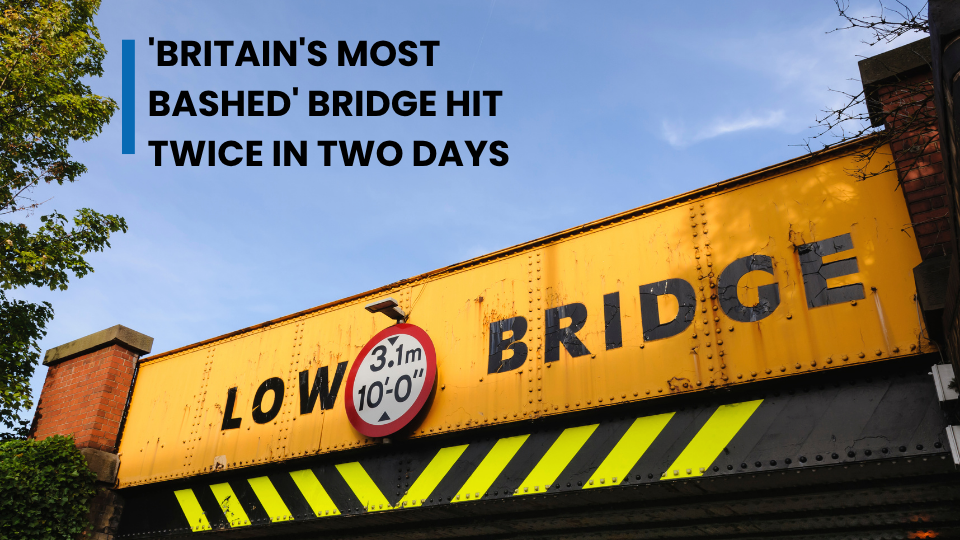
A railway bridge on the A5 Watling Street in Hinckley, Leicestershire, has once again highlighted the ongoing problem of low bridge strikes in the UK after being hit by lorries twice in just two days.
The bridge was struck on Sunday 16 August, resulting in the closure of the A5. A second collision occurred on Monday 17 August, again causing disruption on the road.
According to Network Rail, the bridge was examined following the second incident and no structural damage was found. However, the incident still resulted in disruption, with rail services delayed while the bridge was assessed.
The location is particularly notable because the Watling Street bridge was recorded as Britain’s most-struck railway bridge in 2024/25, with 22 reported strikes during the year.
Why are bridge strikes still happening?
Bridge strikes are not a new problem for the UK transport industry. They remain a regular cause of disruption for both road and rail networks.
Network Rail recorded 1,666 bridge strikes between April 2024 and March 2025, equivalent to approximately one incident every five hours.
Many incidents occur because a driver is unaware of the actual height of their vehicle or fails to account for a low bridge when planning a route.
Vehicle height can also change depending on the load being carried, trailers being used or equipment fitted to the vehicle. This makes accurate vehicle information and route planning particularly important for operators running high-sided vehicles.
Network Rail’s guidance continues to emphasise three straightforward measures: know the height of the vehicle, plan the route and pay attention to low bridge warning signs.
The cost of getting it wrong
A bridge strike can be much more than a damaged vehicle or bridge.
When a vehicle hits a railway bridge, the structure generally needs to be inspected before rail services can safely continue. Roads may also need to be closed while emergency services and infrastructure teams deal with the incident.
Network Rail says bridge strikes can result in significant costs through repairs, inspections, train delays and cancellations. It estimates the average cost of a strike at around £13,000, while the wider annual cost to the UK taxpayer has been estimated at around £23 million.
Even when a bridge suffers no structural damage, as in the latest Hinckley incident, the process of stopping or slowing traffic, securing the area and inspecting the structure can still create unnecessary disruption.
Can technology help prevent low bridge strikes?
Traditional prevention measures remain important. Road signs, height restrictions, route planning and driver awareness all play an essential role.
However, technology can provide an additional layer of protection for fleet operators.
A Low Bridge Warning System can use vehicle-mounted technology to provide drivers with an additional warning when approaching a known low bridge or height-restricted route.
The principle is simple: rather than relying solely on a driver noticing a roadside sign, the vehicle can provide an additional warning directly to the driver.
For fleet managers and transport operators, the consequences of a bridge strike can extend beyond the immediate damage and disruption.
Where a serious incident occurs, the Traffic Commissioner may take an interest in whether the operator had appropriate systems and procedures in place to manage the risk.
This makes bridge-strike prevention part of a wider fleet-management responsibility. Operators are expected to demonstrate that vehicles are being operated safely and that appropriate arrangements are in place for areas such as driver training, vehicle safety and route planning.
How the ACSS Low Bridge Warning System can help
The ACSS Low Bridge Warning System is designed to give commercial vehicle drivers an additional warning when approaching low bridges and other height-restricted locations.
It is not intended to replace road signs, route planning or driver awareness. Instead, it provides another layer of information to help drivers recognise potential hazards before reaching the bridge.
For fleet operators, the objective is straightforward: help reduce the likelihood of avoidable low bridge collisions and the disruption that follows them.
This approach is consistent with the wider direction of the industry. Network Rail has also been exploring how technology can help tackle bridge strikes, including trials using cameras and impact-sensing technology to provide real-time information following an incident.