Direct Vision Standard 2024 Camera Solutions for Compliance
Direct Vision Standard (DVS) is a safety standard set by Transport for London (TFL) an initiative by mayor of London that requires all HGVs over 12 tonnes gross vehicle weight to attain a safety permit to enter or operate in Greater London. The initial Direct Vision Standard was finalised in March 2021 to improve the safety of all road users, including pedestrians, cyclists and motorcyclists. This has been updated to DVS Phase 2 in 2024.
The Direct Vision Standard (DVS) focuses on the visibility of vulnerable road users (VRU) from the drivers view. The standard aims to reduce vehicle blind spots around an HGV where the level of risk to vulnerable road users, such as pedestrian and cyclists near the vehicle is particularly high.
From October 2024 vehicles over 12T (some exceptions apply) gross vehicle weight with a star rating of less than 3 stars will require additional safety equipment to be fitted.
To meet the DVS 2024 requirements 0 to 2 star rated vehicles require a Progressive Safe System to be installed .

Protect fleets from fines and remain compliant for DVS 2024
To meet the DVS 2024 requirements 0 to 2 star rated vehicles require a Progressive Safe System to be installed
DVS Star Rating

All heavy goods vehicles (HGVs) over 12T have a safety star rating determined by the manufacturer. Ratings range from 0 star (lowest) to 5 star (highest). These ratings correspond to the amount of visibility the driver has directly from the cab window and measure the level of risk to vulnerable road users near the vehicle.
The 2024 Direct Vision Standard requires all vehicles with less than 3 star rating to have a DVS Progressive Safe System fitted.
What do you need for being DVS 2024 Compliant?

A Moving Off Information System (MOIS) to detect vulnerable road users in front of the vehicle and provide clear, audible warnings to the driver when necessary.

Blind Spot Information System (BSIS) on the near side of the vehicle to detect vulnerable road users and provide warnings to the driver when necessary.

Camera Monitoring system to completely eliminate the remaining vehicle blind spot at the nearside.

Vehicle must be fitted with audible warning equipment to make nearby pedestrians, cyclist and other road users aware that the vehicle intends to carry out a turning manoeuvre.

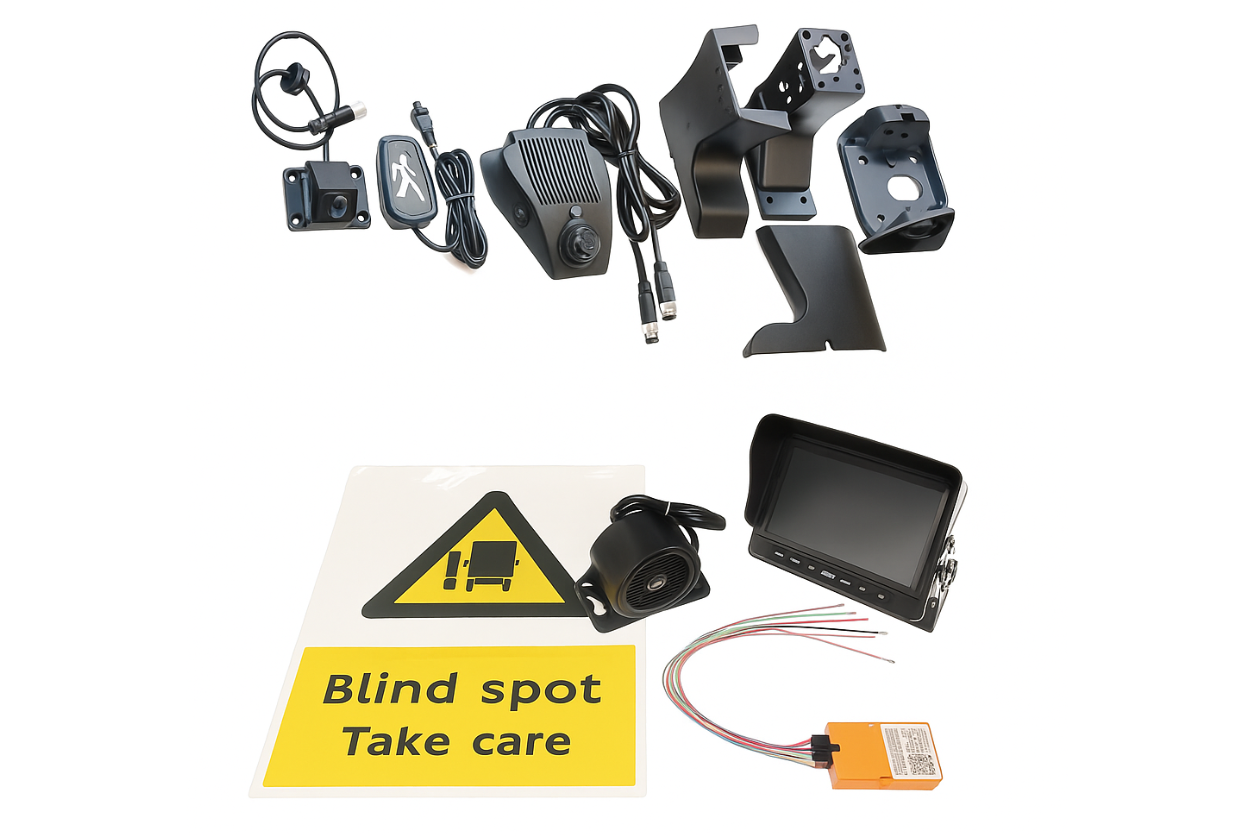
Warning signage as shown must be displayed on the rear of the rigid vehicle
Progressive Safe System
The Progressive Safe System (2024) is made up of some key elements that differentiate it from the previous Safe System.
An active blind spot information system (BSIS) must be fitted to the nearside of the vehicle alerting the driver to the presence of vulnerable road users. Sensors must not activate in response to roadside furniture or stationary vehicles. For articulated vehicles, sensors must be suitably positioned on the tractor unit to provide sufficient coverage of the nearside without being activated by the trailer itself.
A moving off information system (MOIS), camera monitoring system must be fitted to the front of the vehicle alerting the driver to the presence of vulnerable road users. Systems must be activate when the vehicle is stationary and provide an escalated alert if vehicle prepares to move off. A visual signal must show the VRU in the front blind spot with an audible alarm should a collision become imminent.
Existing requirements for Class V & VI mirrors, audible manoeuvring warning, side underrun protection and external pictorial stickers remain for the most part unchanged.
3 Camera System
Get Your Free DVS Guide
Learn more about DVS 2024, Your Guide for DVS, Get a free copy now.

Applying for DVS Permit
DVS Permits are applied for via the TfL web portal.
Application for the Progressive Safe System
Applications will require operators to upload photos of their vehicle with the new PROGRESSIVE SAFE SYSTEM fitted. Specifications of the photos to be uploaded can be HERE. In addition operators must supply a Sensor Functionality Statement. This is a document supplied to their clients by ACSS following PSS installation.
Applications are free of charge, and permits are digital.
All Safe System DVS safety permits for 0 to 2 star rated vehicles will become void midnight 27th October 2024, by when applications will have to be made for Progressive Safe System safety permits under new DVS 2024 regulations. DVS 2024 permits can be applied for HERE.
Vehicles with a star rating of 3 – 5 can obtain a permit with no modification, and vehicles in this category with existing permits will have a new permit granted automatically upon application. Vehicles with a star rating of 0 – 2 stars will have to evidence the fitting of a Progressive Safe System before qualifying for their Progressive Safe System 2024 safety permit.
Penalties
From 26 October 2020, if you drive an HGV within London without a valid safety permit you may receive a penalty charge notice (PCN) of up to £550 (reduced to £275 if paid within 14 days) with a driver receiving a £130 fine.
TFL can also revoke or suspend a permit if a vehicle that has been granted a permit is later found to be in breach of the permit terms.
Penalties for non-compliance will be the same under DVS Phase 1 and DVS Phase 2 from October 2024.
Extension of Grace Period
In it’s inception DVS 2024 was to be enforced from 28th October 2024, with a grace period to allow operators time to fit a PSS until January 2025.
This grace period was to be made available to operators – ON APPLICATION – and was not automatic. Applications for the grace period required operators to make a specific application via their London Road User Charging account supplying:
Evidence that you have installation works arranged to fit the Progressive Safe System but that this is scheduled for after 28 October 2024
Separate applications will need to be made for EACH VEHICLE operators wish to receive a grace period for.
As of 28 October 2024 applications for any grace period are no longer being accepted by TfL. Without a grace period granted prior to this date operators must have a valid Progressive Safe System safety permit or risk incurring PCNs for operators and driver.
Vehicles such as coaches, buses, breakdown vehicles, mobile cranes, emergency vehicles and showman’s vehicles are exempt from requiring a DVS Safety Permit. If your vehicle requires a permit now it will under DVS 2024. The easiest way to confirm is to check your vehicles star rating and registration on the TfL DVS page.
You can fit a PSS Progressive Safe System now or anytime up till the regulation change in October 2024. DVS Safety Permits can be attained now evidencing a PSS but will still have to be reapplied for under the new regulations from June 2024. The process for applying for a Safety Permit under DVS 2024 will be very similar to the current system requiring photo evidence. Additionally, operators will need to provide a Sensor Functionality Statement.
Under DVS 2024 you will still require a Safety Permit to operate in Greater London although no modifications are required to your vehicle now or for DVS 2024. You will however need to reapply for a DVS Safety Permit under the new regulations from June 2024.
Progressive Safe System cost starting from from circa £1,000 + VAT is available fully fitted & calibrated Upgrade packages also available.
Certain elements of a Safe System can be used. These are likely to be the in-cab monitor and, in some cases, the nearside camera. Additional equipment will need to be fitted.
The scope of DVS 2024 is changing. A 1-star vehicle currently requires no modifications. Under DVS 2024 a 1-star vehicle will require a Progressive safe System fitted. The same will apply for 2-star vehicles which currently does not require any modifications.
The choice is yours. You can install either system now to obtain your permit. If you opt for a Safe System you will need to upgrade to a PSS by October 2024. Whichever
system you install you will need to reapply for a Safety Permit under the new DVS 2024 requirements from June 2024.