While the UK has some of the safest roads globally, approximately four people still die on them every day, with thousands more seriously injured every year; in 2024, there were over 1600 deaths and 28,000 people seriously injured on Britain’s roads. Though the UK has historically been a global leader in road safety, over the past decade 22 European countries have made more progress in reducing road fatalities, with the UK slipping from 3rd safest country in Europe in terms of road deaths in 2023, down to 4th in 2024. Progress in reducing the number of road deaths and serious injuries in the UK has slowed since 2010, with the numbers remaining relatively unchanged.
Vulnerable road users, such as pedestrians, cyclists, motorcyclists and children, remain disproportionately at risk of serious injuries and fatalities. These fatalities and serious injuries are preventable; through stricter enforcement, education, and safer roads, the number of lives lost can be reduced. The UK government has committed to making improvements in road safety a political priority, devising a new Road Safety Strategy with clear targets; a 65% reduction in the number of people killed or seriously injured on roads in Great Britain by 2035, and a 70% reduction in the number of children under 16 killed or seriously injured on roads in Great Britain by 2035, using 2022-2024 figures as a baseline.
The Road Safety Strategy is organised into four themes, detailing the interventions the government is undertaking to improve road safety; supporting road users, ensuring infrastructure is safe, robust enforcement to protect all road users, and taking advantage of technology for safer vehicles.
Taking advantage of technology for safer vehicles
Advances in vehicle safety technology offer a significant opportunity to prevent collisions and protect the most vulnerable road users. The government has committed to ensuring that new vehicles entering the market in Great Britain comply with the latest safety standards, and are consulting on mandating the fitting of 18 new safety technologies. These technologies will apply to specific vehicle categories produced in unlimited series under the Great Britain type approval scheme.
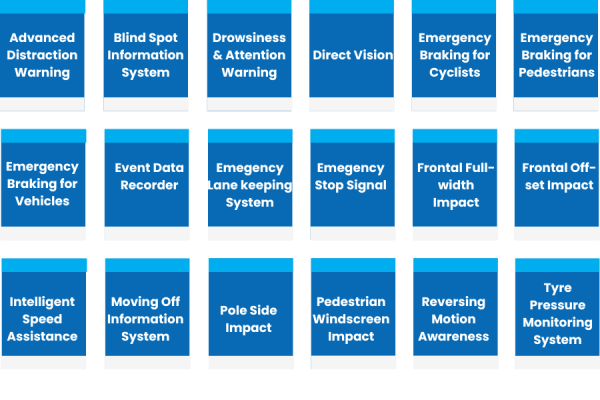
Technologies under consideration:
- Advanced Distraction Warning (ADW) – detects distraction (e.g. signs of fatigue, mobile phone use) and issues an alert to the driver to resume attentive driving.
- Blind Spot Information System (BSIS) – informs the driver when a cyclist is close to the nearside of the vehicle and warns the driver when a turning collision on the nearside becomes more likely.
- Drowsiness and attention warning (DAW) – detects driver drowsiness and inattention through system analysis over a period of erratic driving and steering input, and issues an alert to resume normal attentive driving or to take a rest.
- Direct Vision (DIV) – vehicle design requirement which ensures that a minimum volume in proximity to the vehicle’s front, nearside and offside can be observed by the driver in direct vision (i.e. without the aid of mirrors or cameras) to allow detection of pedestrians and cyclists.
- Emergency braking for cyclists (EBC) – warns the driver and automatically brakes when a frontal collision with a cyclist crossing the road is imminent.
- Emergency braking for pedestrians (EBP) – warns the driver and automatically brakes when a frontal collision with a pedestrian is imminent.
- Emergency braking for vehicles (EBV) – warns the driver and automatically brakes when a frontal collision with a preceding car is imminent.
- Event data recorder (EDR) – records critical, crash-related parameters before and during a collision to support crash reconstruction and research.
- Emergency lane keeping system (ELKS) – warns the driver of unintended lane departures and corrects the vehicle’s course to avoid crossing solid lane markings. The driver can maintain control and override the system at any time by taking a deliberate action, such as steering or other control input.
- Emergency stop signal (ESS) – indicates high braking deceleration to other road users to the rear of the vehicle by a rapid flashing of all the stop lamps or all the direction indicators. Drivers following a hard-braking vehicle are therefore able to take appropriate action.
- Frontal full-width impact (FFI) – Crash test to help ensure all vehicle occupants benefit from comparable levels of protection in a frontal impact irrespective of sex, age or stature by engaging the entire width of the vehicle and using different sized crash test dummies and injury criteria appropriate for older occupants.
- Frontal off-set impact (FOI) – Crash test to improve the protection of vehicle occupants in a frontal impact where only part of the front of a vehicle strikes another object (like another car or a barrier), rather than the full width.
- Intelligent speed assistance (ISA) – warns the driver or slows the vehicle down when the speed limit is being exceeded. Speed limit information is provided through optical recognition of maximum speed signs and detailed map data. It will be possible for the driver to deactivate or override the system.
- Moving off information system (MOIS) – informs the driver when a pedestrian or cyclist is in the blind spot area in front of the vehicle and warns the driver when a moving off or low-speed impact with the vehicle front is likely.
- Pole side impact (PSI) – Crash test to assess the performance of vehicles in an impact with a rigid narrow object.
- Pedestrian windscreen impact (PWI) – Head impact test to improve the secondary safety of pedestrians in impacts with the vehicle’s windscreen.
- Reversing motion awareness (RMA) – aids the driver in visually observing or detecting pedestrians or cyclists behind the vehicle when reversing.
- Tyre pressure monitoring system (TPMS) – warns the driver of incorrect tyre pressure due to punctures or gradual loss of pressure over time.
Aligning EU and GB safety standards
Confusion regarding EU and GB vehicle safety standards stems from a misalignment following Brexit. The vehicle technologies proposed under the GB type approval scheme would apply to manufacturers marketing or registering vehicles and components in Great Britain, and is based on EU legislation. In 2019, the EU agreed amendments to its existing General Safety Regulation (GSR2), mandating certain advanced driver assistance systems (ADAS) from July 2024 for new vehicles sold within the EU, and although the UK participated in the development of this regulation, the fitment of these safety features is not currently mandated in GB as the regulation was implemented after the UK’s exit from the EU. However, these safety features are also mandatory in Northern Ireland, resulting in differing safety requirements between GB and NI, and further adding to the confusion. While it is unclear to what extent manufacturers will offer different vehicles in GB compared to the EU and NI, there is a risk that misalignment of safety requirements and varied vehicle specifications across the UK could create uncertainty for vehicle manufacturers and dealerships and potentially lead to increased costs, with consumers in GB potentially paying extra for technologies provided at no additional cost in the EU and NI. Better alignment of safety standards between GB and NI will support manufacturers to ‘dual mark’ vehicles as being approved to both GB and EU schemes, allowing vehicles to be sold throughout the UK without any additional restrictions. The mandating of these safety features aims to align safety standards both across the UK between GB and NI, and with those of the EU, providing clarity for both manufacturers and consumers, avoiding unnecessary costs and ensuring that GB drivers are not left behind as vehicle safety standards evolve.
The Role of ADAS and DMS
The use of these vehicle technologies could hugely improve road safety for passengers, pedestrians and cyclists across the UK, with the Department for Transport reporting that over a 15-year period, these technologies have the potential to prevent more than 758,000 collisions and 65,000 casualties on UK roads.
Analysis of collision statistics indicates that inappropriate speed and driver distraction and fatigue are the primary factors contributing to road collisions, and technologies such as Advanced Driver Assistance Systems (ADAS), which include features such as advanced emergency braking and lane-keeping assistance, can be invaluable tools in preventing collisions arising from human error. Advanced Driver-Assistance Systems use cameras, sensors and radars to enhance safety by detecting and providing alerts for unsafe driving behaviours, such as harsh braking and steering and lane departures. Driver Monitoring Systems (DMS) use a driver facing camera which can detect signs of fatigue or distraction, and provide real time alerts to drivers if needed. These technologies enhance driver awareness, reducing the risk of human error as a cause of road collisions.
However, experts warn that mandatory fitment does not guarantee safer roads if technology is switched off, misunderstood or misused. A recent study by Brake found that 18% of drivers are uncertain what safety features their vehicle has, and 63% of drivers don’t understand what all the safety features in their vehicle do. An additional 35% also admitted to finding alerts irritating and have switched off at least one safety feature as a result. Drivers must understand how to use these systems correctly and safely, and without clear guidance, there is a risk that ADAS will be underused or misused, limiting its effectiveness. As ADAS technologies continue to advance, the government has committed to collaborating with the industry to ensure provision of clear, accurate information about ADAS functionality, limitations and user responsibilities, to ensure their integration into the vehicle fleet is both safe and effective.
Retrofitting ADAS and DMS
Though the proposed requirements don’t currently include retrofitting of ADAS into older vehicles, the benefits of these safety technologies are unquestionable, and fleet operators are increasingly moving beyond simple compliance to a more proactive safety culture. ADAS can detect driver fatigue and distraction and provide alerts to the driver before escalating into major incidents, not only reducing the immediate risks but also helping to shape better driving habits over time. With drivers becoming more aware of their actions and being able to adjust their driving behaviour accordingly, the result is a safer and more consistent performance on the road.
Better insight into driving behaviour doesn’t just enhance safety; fleets using these technologies report fewer collisions, lower insurance premiums and less downtime. A reduction in collisions can lead to a reduction in congestion which allows for the more effective movement of goods for businesses and improved supply chains. Furthermore, having video evidence in disputed incidents is invaluable, protecting drivers and reducing both claim time and costs, and continuous insights into driver behaviour over time helps operators benchmark performance, spot training needs early and run vehicles more efficiently.
ACSS fleet safety solutions
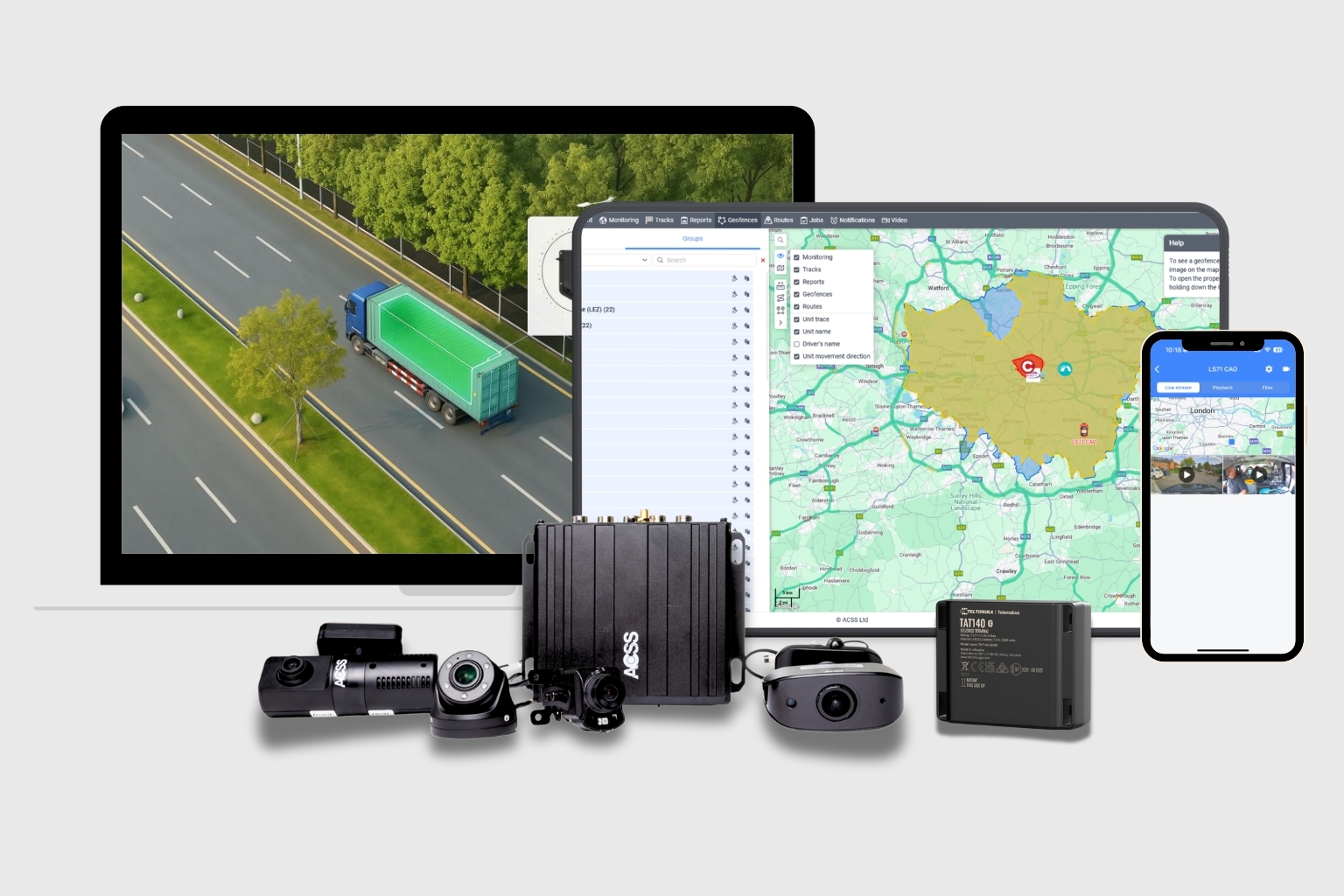
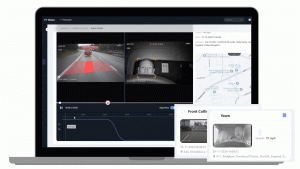
ACSS’s Driver Monitoring System and Advanced Driver Assistance System provide fleets with a comprehensive safety solution. The DMS includes a driver facing camera that monitors drivers for signs of fatigue, distraction or mobile phone use and provides real time alerts to drivers, with the front-facing ADAS camera working alongside it to identify lane departures, forward collisions or sudden braking risks. These alerts are delivered directly in the cabin through the R-Watch, providing both audible and visible warnings that prompt immediate driver response.
The ACSS system connects to a cloud-based platform, enabling fleet managers to review event footage and identify recurring patterns in driver behaviour, an approach which not only enhances compliance but also improves overall fleet safety and accountability.
ACSS Advanced Driver Assistance System (ADAS):
Helps prevent collisions and keeps drivers alert on the road.
- Forward Collision Warning (FCW) – Alerts drivers of imminent collisions.
- Lane Departure Warning (LDW) – Alerts drivers when drifting from lanes.
- Headway Monitoring Warning – Alerts when following distance is unsafe.
- Pedestrian Collision Warning (PCW) – Detects pedestrians, prevents accidents.
ACSS Driver Monitoring System (DMS):
Monitors driver behaviour and ensures compliance with safety rules.
- Fatigue Detection – Identifies drowsiness, prompts alert.
- Smoking Detection – Detects driver smoking in cabin.
- Seatbelt Monitoring – Alerts if seatbelt not fastened.
- Driver Identification – Recognises driver and logs attendance.
- No Driver Alert – Notifies fleet if no driver detected.
Driving Behaviour & Performance Monitoring:
Tracks driving habits to improve safety and efficiency.
- Harsh Braking – Detects sudden braking events.
- Sharp Turning – Monitors aggressive cornering or turns.
- Rapid Acceleration/Deceleration – Tracks abrupt speed changes.
- Speeding – Alerts on exceeding safe speed limits.
R-Watch (Driver Alert System):
Provides real-time visual and audible alerts for proactive safety.
- Visual Alerts – On-screen warnings for immediate driver attention.
- Audible Alerts – Beeps, chimes, or voice warnings for hazards.
- Proactive Safety – Combines ADAS and DMS data to prevent incidents.
- Two-Way Feedback – Supports real-time communication between driver and operator.

The new Road Safety Strategy is a call to action, to work together to reduce casualties and improve safety on UK roads. Advancements in technology are transforming the landscape of road safety, offering the potential to protect lives; by integrating proven safety technologies, the likelihood and severity of collisions can be reduced, and many deaths and serious injuries can be prevented.