Every minute a vehicle sits stationary with its engine running, it burns fuel and covers zero miles. With UK diesel close to £2 a litre in October 2026, unnecessary idling has become one of the easiest costs for a fleet to cut, as long as you can see it.
What is vehicle idling?
Vehicle idling is when a vehicle’s engine is running, but the vehicle is not moving. Some idling is unavoidable, such as sitting in traffic or at lights. Much of it is not. Common causes of unnecessary idling in commercial fleets include:
- Waiting at a customer site for loading or unloading
- Keeping the cab warm or cool during breaks
- Leaving the engine running during short drop-offs
- Warming up the engine for longer than needed on cold mornings
- Waiting for a collection, a booking slot or a colleague
The challenge for fleet managers is that idling is usually invisible. A driver idling for 15 minutes at each of four drops can add an hour of wasted engine time to every shift, without anyone in the office knowing.
How much does vehicle idling cost a business?
One hour of idling a day can cost around £1,500 a year per HGV at current diesel prices. Idling vans typically burn 0.8 to 1.5 litres of fuel per hour, and HGVs 2 to 4 litres per hour (Right Fuel Card). UK diesel averaged 198.8p per litre in the week to 18 October 2026 (Fuel Finder UK).
| Vehicle | Litres per idle hour | Cost per idle hour | Per year, 1 hr/day | 50 vehicles |
|---|---|---|---|---|
| Van (diesel) | 0.8–1.5 | ~£2.29 | ~£572 | ~£28,600 |
| HGV (diesel) | 2–4 | ~£5.97 | ~£1,493 | ~£74,600 |
Based on the midpoint of each range (1.15 L/hour for vans, 3 L/hour for HGVs), diesel at £1.99 per litre and 250 working days a year.
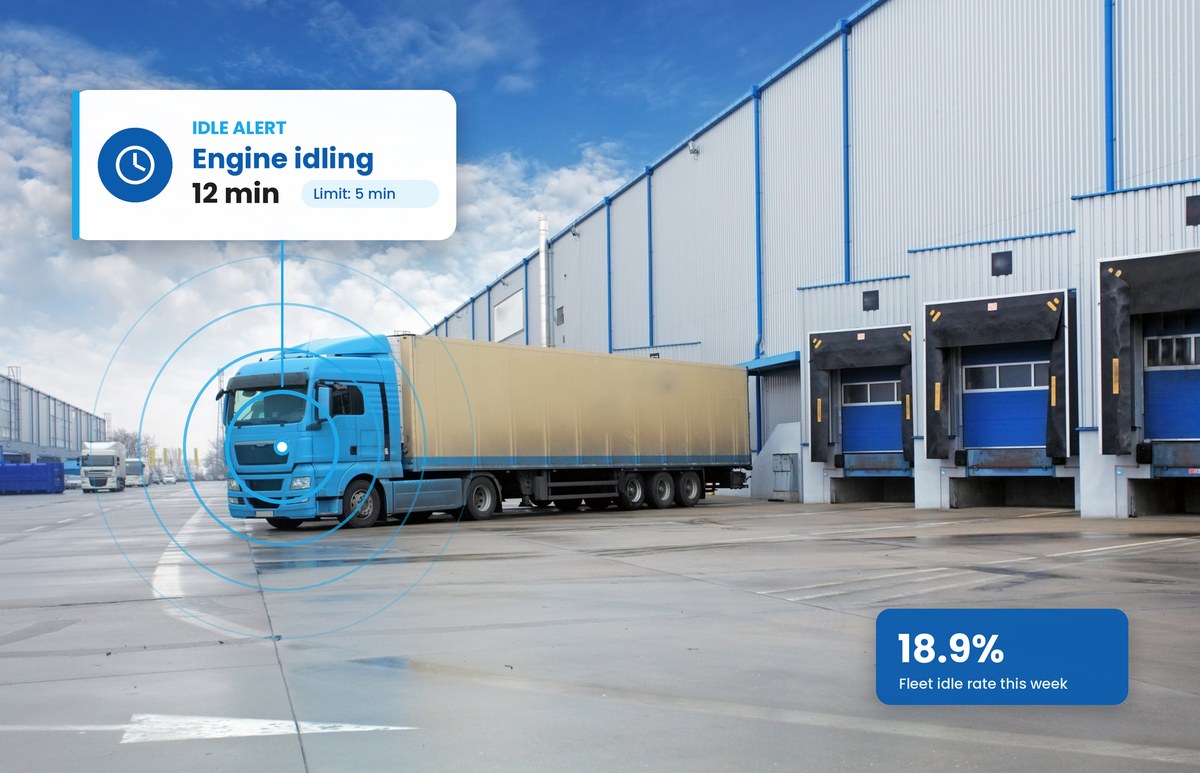
18.9%
of the day idling
A real-world example from AC Cloud: one vehicle had a 6 hour 10 minute working day, of which 1 hour 10 minutes was spent idling. For an HGV, that’s around 3.5 litres of diesel, or about £7 a day. Over 250 working days, roughly £1,740 for one vehicle.
How much does vehicle idling cost a business?
One hour of idling a day can cost around £1,500 a year per HGV at current diesel prices. Idling vans typically burn 0.8 to 1.5 litres of fuel per hour, and HGVs 2 to 4 litres per hour (Right Fuel Card). UK diesel averaged 198.8p per litre in the week to 18 October 2026 (Fuel Finder UK).
| Vehicle | Fuel burned idling (L/hour) | Cost per idle hour | Cost per year, 1 hour/day | Cost per year, 50 vehicles |
|---|---|---|---|---|
| Van (diesel) | 0.8–1.5 | ~£2.29 | ~£572 | ~£28,600 |
| HGV (diesel) | 2–4 | ~£5.97 | ~£1,493 | ~£74,600 |
Based on the midpoint of each range (1.15 L/hour for vans, 3 L/hour for HGVs), diesel at £1.99 per litre and 250 working days a year.
A real-world example from AC Cloud: the idle report below shows a vehicle with a 6 hour 10 minute working day, of which 1 hour 10 minutes (18.9%) was spent idling. For an HGV, that is around 3.5 litres of diesel, or about £7 a day. Over 250 working days, it adds up to roughly £1,740 for one vehicle.
Fuel is only part of the cost. Idling also:
• Adds engine hours without adding miles, which can bring service intervals forward
• Increases wear on engine components, as an engine is not running at its most efficient temperature or load while idling
• Can lead to fines if drivers idle on public roads (see the legal rules below)
• Raises your fleet’s reported emissions, which matters for customers and tenders that ask for carbon data
The hidden risks of vehicle idling
Fuel is the most visible cost, but idling also affects your vehicles, your drivers and your security.
Engine wear and DPF problems
An idling engine runs below its ideal temperature, so fuel doesn’t burn completely. This leaves residue that can build up in the engine and exhaust system.
For modern diesels, there’s an extra problem. The diesel particulate filter (DPF) needs high exhaust temperatures to burn off soot. Long periods of idling keep temperatures low, so soot builds up, which can lead to forced regenerations, warning lights and costly DPF repairs.
Idling also adds engine hours without adding miles, which can bring service intervals forward.
Driver health
Drivers who sit in or around idling vehicles breathe in the fumes. Exhaust emissions such as nitrogen dioxide and fine particles are linked to heart and lung disease (Welsh Government). Reducing idling makes the cab and the loading area a healthier place to work.
Vehicle theft
A vehicle left idling and unattended is one of the easiest vehicles to steal. A thief only needs to get in and drive away.
Rule 123 of the Highway Code says you must not leave a parked vehicle unattended with the engine running. Many insurance policies also exclude theft when keys are left in an unattended vehicle, so an idling theft could leave the business paying for the vehicle and its load.
This is a particular risk on multi-drop routes, where drivers may leave the engine running for a “quick” delivery. Combining an idling policy with vehicle tracking and cargo monitoring reduces both the chance of theft and the time it takes to respond.
Vehicle idling statistics in the UK
- Diesel hit a record high in 2026. The RAC put the UK average at 199.18p per litre on 30 September 2026, beating the previous June 2022 record (PetrolPrices.co.uk).
- Up to twice the emissions. An idling engine can produce up to twice the exhaust emissions of a vehicle in motion, according to the RAC (Autocar).
- Councils are stepping up enforcement. Richmond council reported around 10,000 idling interventions a year by enforcement officers, while Hillingdon issued around 7,200 fixed penalty notices using a Public Spaces Protection Order (Local Government Lawyer).
- Fines in Wales rose sevenfold. From 30 September 2026, the Welsh fixed penalty for stationary idling rose from £20 to between £75 and £150 (Welsh Government).
- Every litre counts for carbon reporting. UK pump diesel (B7) emits about 2.57 kg CO2e per litre burned, using the UK Government’s 2025 conversion factors (Green Calculus, citing DESNZ).
Is vehicle idling illegal in the UK?
Yes, unnecessary idling on a public road is an offence. Rule 123 of the Highway Code says drivers must not leave a parked vehicle unattended with the engine running, or leave an engine running unnecessarily while stationary on a public road (Welsh Government).
How it is enforced depends on where you operate:
For fleet operators, individual fines are small. The bigger risk is repeated penalties across many drivers, reputational damage when branded vehicles are seen idling outside schools or homes, and the lack of a clear idling policy if a customer or regulator asks.
The environmental impact of vehicle idling
One hour of idling a day adds nearly 2 tonnes of CO2e a year to a single HGV’s footprint. That figure comes from the 750 litres of diesel in the cost example above, at 2.57 kg CO2e per litre. Across 50 HGVs, it is roughly 96 tonnes a year from vehicles that are not moving.
Idling also releases nitrogen dioxide (NO2) and particulate matter (PM2.5), which harm local air quality. The Welsh Government links idling emissions to heart and lung disease, with children outside schools and people near healthcare settings most exposed (Welsh Government).
For operators, this matters beyond compliance. More customers and public-sector tenders now ask for carbon and emissions data. Cutting idling is one of the quickest ways to show measurable progress without changing vehicles.
How to track and reduce vehicle idling with AC Cloud
You can’t reduce what you can’t measure. AC Cloud, the ACSS platform for live-view vehicle CCTV and telematics, records idle time on every trip automatically, so fleet managers can see exactly where, when and how long vehicles are idling.
See every feature in one place: Vehicle idle monitoring with AC Cloud →
Vehicle idle reports and idle rate
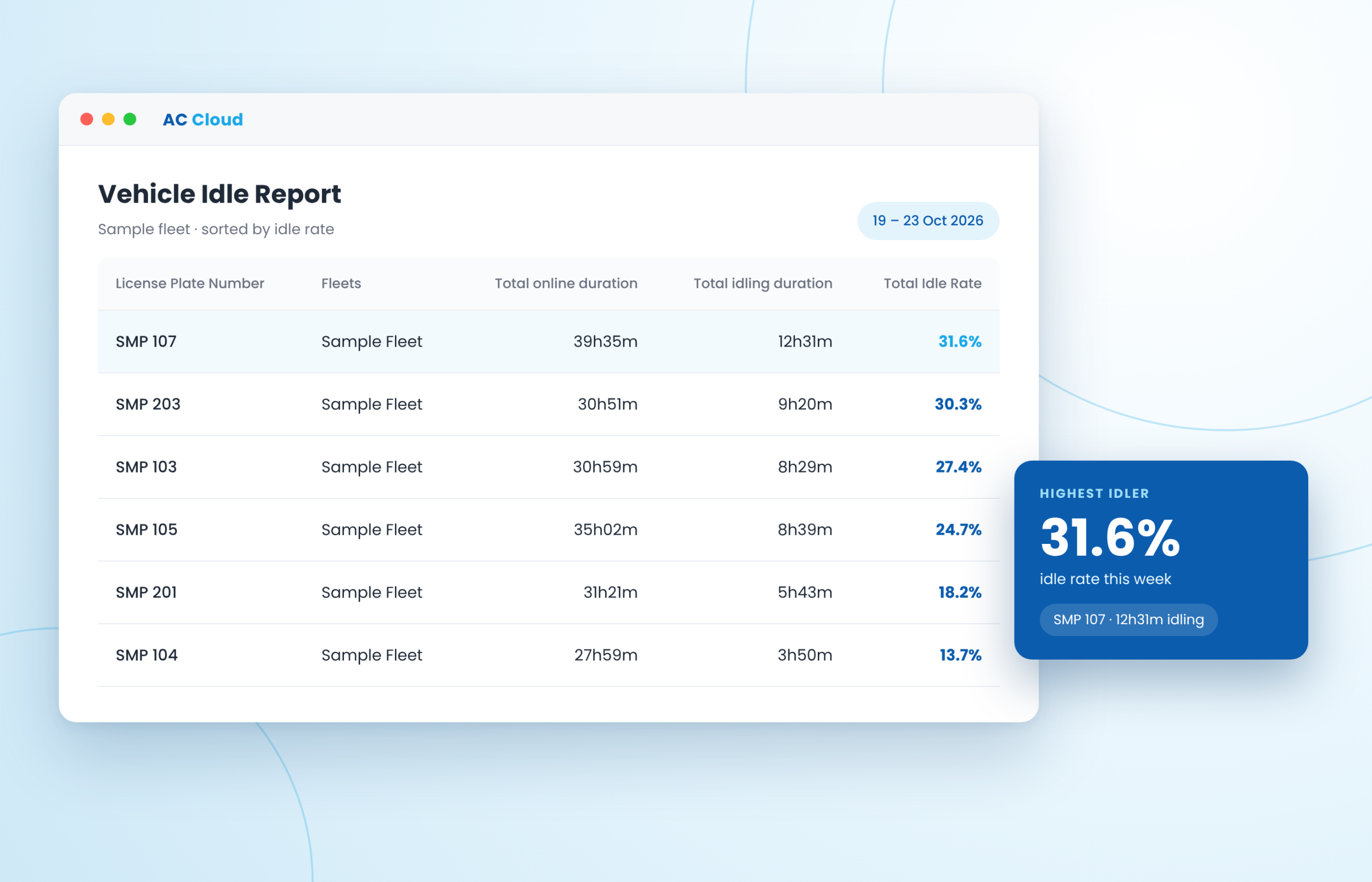
AC Cloud breaks every trip into driving duration and idle time, and calculates the idle percentage for each vehicle. Managers can quickly spot the vehicles, drivers or routes with the highest idle rates and compare them across days and weeks.
Scheduled idle reports
Idle reports can be scheduled to arrive automatically, for example every Monday morning, so idling is reviewed regularly rather than only when fuel bills rise.
Want to see one? Download a sample weekly idle report showing idle rate, idle cost and alerts for each driver in an example fleet.
Real-time idling alerts
Set an idle time threshold, such as 5 minutes. If a vehicle idles beyond that limit, AC Cloud sends a push notification to the fleet operator, so the driver can be contacted while it is still happening.
Trip history, parking duration and location
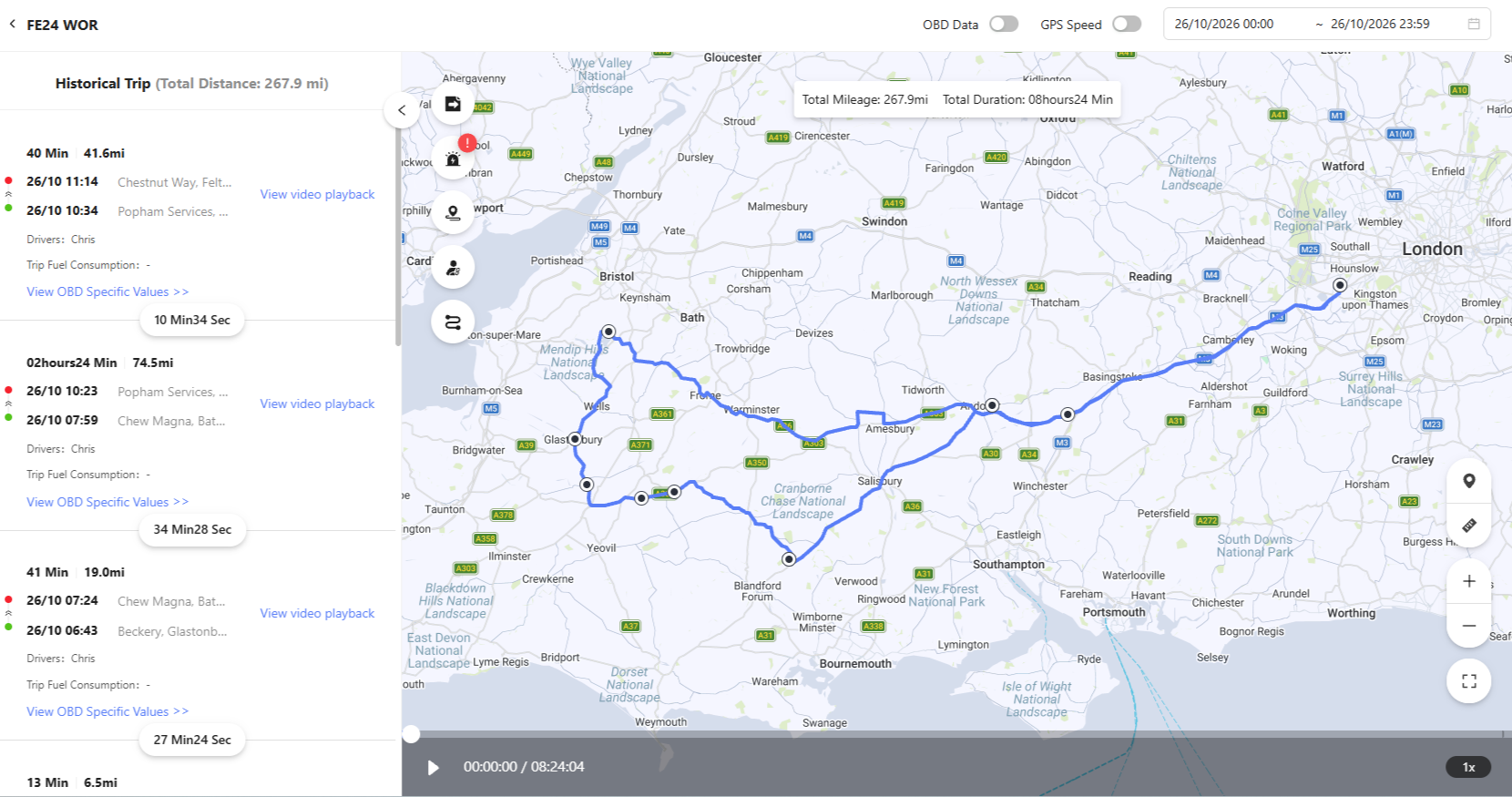
The historical trip view shows each stop, its duration and its location on the map, alongside total mileage and trip time. This helps managers see whether idling happens at particular customer sites, depots or rest stops.
[Insert screenshot: AC Cloud historical trip view with parking duration]
Linking idling to fuel consumption and mileage
With OBD data enabled, idle time can be viewed alongside fuel consumption and vehicle mileage. This makes it easier to put a real cost on idling and track savings over time.
More context with AI driver cameras
Fleets that also use ACSS AI driver cameras can review video playback for any trip or stop. This adds context to idle events, helping managers understand what was happening in and around the vehicle before speaking with the driver.
See it in practice: read how a 40-lorry food and drink distributor could cut idling by 40% and save around £28,000 a year using these AC Cloud features.
6 practical ways to reduce idling in your fleet
- Set a clear idling policy. Define when idling is acceptable, for example, “switch off if stopped for more than 2 minutes, except in traffic.”
- Measure your baseline. Use idle reports to find your current idle rate before setting targets.
- Use real-time alerts. Set a threshold that suits your operation and act on alerts while idling is happening.
- Coach, don’t just police. Share idle data with drivers and recognise those who improve.
- Look for patterns at sites. If idling clusters at certain customer sites or depots, the cause may be waiting times, not driver habits.
- Track the savings. Compare idle time and fuel use month by month to show the return on your efforts.
See your fleet’s idle time in AC Cloud
Most fleets underestimate how much time their vehicles spend idling. AC Cloud shows you idle time, idle rate, and the fuel cost for every vehicle, with scheduled reports and real-time alerts to help you act.
Book a 15-minute AC Cloud demo to see your idle data in action.
Not ready for a demo? Download a sample idle report to see what AC Cloud shows you each week.